“Well,” Miss Hayden said, “I think it’s going to get better.”
“Hard to say,” said one of the boys as they drifted back to their cars.
At midnight in the camp, Charles Mauldin, aged seventeen, the head of the Dallas County Student Union and a student at Selma’s Hudson High School, which is Negro, was awakened in the security tent by several guards, who ushered in a rather frightened-looking Negro boy.
“What’s going on?” asked Charles.
The boy replied that he was trying to found a Negro student movement in Lowndes County.
“That’s fine,” said Charles.
“The principal’s dead set against it,” the boy said.
“Then stay underground until you’ve got everybody organized,” Charles said. “Then if he throws one out he’ll have to throw you all out.”
“You with Snick or S.C.L.C., or what?” the boy asked.
“I’m not with anything,” Charles said. “I’m with them all. I used to just go to dances in Selma on Saturday nights and not belong to anything. Then I met John Love, who was Snick project director down here, and I felt how he just sees himself in every Negro. Then I joined the movement.”
“What about your folk?” the boy asked.
“My father’s a truck driver, and at first they were against it, but now they don’t push me and they don’t hold me back,” Charles said.
“Who’ve you had personal run-ins with?” the boy asked.
“I haven’t had personal run-ins with anybody,” Charles said. “I’ve been in jail three times, but never more than a few hours. They needed room to put other people in. Last week, I got let out, so I just had to march and get beaten on. In January, we had a march of little kids—we called it the Tots March—but we were afraid they might get frightened, so we joined them, and some of us got put in jail Nothing personal about it.”
“Some of us think that for the march we might be better off staying in school,” the boy wid.
“Well, I think if you stay in school you’re saying that you’re satisfied,” Charles said. “We had a hundred of our teachers marching partway with us. At first, I was against the march, but then I realized that although we’re probably going to get the voting bill, we still don’t have a lot of other things. It’s dramatic, and it’s an experience, so I came. I thought of a lot of terrible things that could happen, because we’re committed to non-violence, and I’m responsible for the kids from the Selma school. But then I thought, If they killed everyone on this march, it would be nothing compared to the number of people they’ve killed in the last three hundred years.”
“You really believe in non-violence?” the boy asked Charles.
“I do,” Charles said. “I used to think of it as just a tactic, but now I believe in it all the way. Now I’d just like to be tested.”
“Weren’t you tested enough when you were beaten on?” the boy asked.
“No, I mean an individual test, by myself,” Charles said. “It’s easy to talk about non-violence, but in a lot of cases you’ve got to be tested, and re-inspire yourself.’
By 2 a.m., hardly anyone in the camp was awake except the late-shift night security patrol and a group of radio operators in a trader truck, which served as a base for the walkie-talkies around the campsite and in the church back in Selma. The operators kept in constant touch with Selma, where prospective marchers were still arriving by the busload. Inside the trailer were Norman Talbot, a middle-aged Negro from Selma who had borrowed the trailer from his uncle and was serving as its driver (“I used to work in a junk yard, until they fired me for joining the movement. I’ve got a five-year-old daughter, but after that I made it my business to come out in a big way’); Pete Muilenberg, a nineteen-year-old white student on leave of absence from Dartmouth to work for C.O.F.O., the Congress of Federated Organizations, in Mississippi; and Mike Kenny, a twenty-nine-year-old white student who had quit graduate school at Iowa State to work for S.N.C.C.
“Snick isn’t officially involved in this march,” Mr. Kenny said to a marcher who visited him in the trailer early that morning. “Although individual Snick workers can take part if they like. They say Martin Luther King and Snick struck a bargain: Snick wouldn’t boycott this march if S.C.L.C. would take part in a demonstration in Washington to challenge the Mississippi members of Congress. We didn’t want to bring in all these outsiders, and we wanted to keep marching on that Tuesday when King turned back. Man, there are cats in Selma now from up North saying, ‘Which demonstration are you going to? Which one is the best? As though it were a college prom, or something. I tell them they ought to have sense enough to be scared. ‘What do you think you’re down here for? For publicity, to show how many of you there are, and to get a few heads bashed in. Nobody needs you to lead them. S.C.L.C. has got plenty of leaders.’ People need Snick, though, for the technicians. Some of us took a two-day course in short-wave-radio repair from one of our guys, Marty Schiff, so we could set up their radios for them. Then, a lot of Snick cats have come over here from Mississippi, where the romance has worn off a bit and it’s time for our experts to take over—running schools, pairing off communities with communities up North, filing legal depositions against the Mississippi congressmen and against the worst of the police. We’re called agitators from out of state. Well, take away the connotations and agitation is what we do, but we’re not outsiders. Nobody who crosses a state line is an outsider. It’s the same with racial lines. I don’t give a damn about the Negro race, but I don’t give a damn about the white race, either. I’m interested in breaking the fetters of thought. What this march is going to do is help the Alabama Negro to break his patterns of thought. It’s also going to change the marchers when they go hack home. The students who went back from the Mississippi project became dynamos. It’s easier to join the movement than to get out. You have this commitment. There will be Snick workers staying behind to keep things going in Selma. We were here, working, a year and a half before S.C.L.C, came in. Man, there’s a cartoon in our Jackson office showing the Snick power structure, and it’s just one big snarl. Some of us are in favor of more central organization, but most of us believe in the mystique of the local people. We’re not running the C.O.F.O. project in Mississippi next summer, because of the black-white tensions in Snick. Some of the white cats feel they’re being forced out, because of the racism. But I can understand it. The white invasion put the Negro cats in a predicament. Not even their movement was their own anymore. I’m staying with it, though. Every Snick meeting is a traumatic experience for all of us, but even the turmoil is too real, too important, for me to get out now. It’s what you might call the dramatic-results mentality. Some of the leaders may be evolving some pretty far-out political philosophy, but it’s the workers who get things done—black-white tensions, left-right tensions, and all.”
Later that morning, Tuesday, it began to rain, and the rain continued through most of the day. When the first drops fell, whites at the roadside cheered (a Southern adage states that “a nigger won’t stay out in the rain”), but it soon became apparent that, even over hilly country, the procession was going at a more spirited pace than ever. Jim Letherer, on his crutches, appeared to be flagging. John Doar walked beside him for a while, joking and imperceptibly slowing his pace. Then Mr. Doar said, “Jim, come to the car a minute. I want to show you something back down the road.” Jim disappeared from the march. In twenty minutes, he was walking again.
Back in Selma, thousands of out-of-towners had arrived and had been quietly absorbed into the Negro ghetto. On the outskirts of town, a sign had appeared showing a photograph of Martin Luther King at the Highlander Folk School and captioned “Martin Luther King at Communist School.” Lying soggily upon the sidewalks were leaflets reading “An unemployed agitator ceases to agitate. Operation Ban. Selective hiring, firing, buying, selling.” The Selma Avenue Church of Christ, whose congregation is white, displayed a sign reading “When You Pray, Be Not As Hypocrites Are, Standing in the Street. Matt: 6:5,” and the Brown Chapel Church displayed a sign reading “Forward Ever, Backward Never. Visitors Welcome.” Inside the church and its parsonage, things were bustling. There were notes tacked everywhere: “If you don’t have official business here, please leave,” “All those who wish to take hot baths, contact Mrs. Lilly,” “Don’t sleep here anymore. This is an office,” “Please, the person who is trying to find me to return my suit coat and trenchcoat, not having left it in my Rambler . . . ”
“Everyone here in town is getting antsy,” Melody Heap, a white girl who had come in from Chicago, said to a reporter. “We’re not allowed to march until Thursday, and there’s nothing to do. On the other hand, we’re giving the Selma Negroes a chance to take it easy. They know what they’re doing, and we don’t, so they can order us around a little.”
“You know what just happened?” aid a white clergyman from Ontario. “Some of those white segs splashed mud all over us. It was so funny and childish we just howled.”
A little later, two clergymen picked their luggage and left the church for the home of Mrs. Georgia Roberts, where, they had been told, they were to spend the night.
“I guess I can put you up,” Mrs. Roberts said when they arrived. “Last night, I put up fourteen. I worked as a cook at the Selma Country Club for thirteen years, before they fired me for joining the movement. I’ve been friendly to all the other guests, so I guess you’ll find me friendly, too. I never thought I’d see the day when we’d dare to march against the white government in the Black Belt of Alabama.”
At the Tuesday-night campsite, a farm owned by the A. G. Gastons, a Birmingham Negro family who had become millionaires in various businesses, the ground was so wet that the marchers could walk through the clay-like mud only by moving their feet as though they were skating. A Negro family living in the middle of the property had received several intimidating phone calls during the day, and as a consequence they barred their house to marchers. They held a party in their little front garden to watch the goings on.
The marchers had by then been joined by Mrs. Ann Cheatham, an English housewife from Ealing, who had flown across the Atlantic just to take part in the last two days of marching. “It seems to me an outrage,” she said. “I saw it on the telly—people being battered on the head. I came to show that the English are in sympathy. I can see there are a lot of odd bods on this march, but there were a lot in the marches on Aldermaston and Washington. This appalling business of barring white facilities to Negro children! People say it’s not my business, but I would deny that. It’s everybody’s business.”
In the early evening, a clergyman became violently ill, and doctors blamed the marchers’ water supply. The marchers had all along complained that the water tasted of kerosene, and upon investigation, it turned out that the water was in fact polluted, having come from a truck that was ordinarily used for draining septic tanks. (Fortunately, no other marchers seemed to suffer from the contamination.) Later, the singer Odetta appeared at the campsite, and found all the marchers, including another singer, Pete Seeger, fast asleep.
Wednesday, the fourth and last full day of marching, was sunny again, and the marchers set out in good spirits. In the morning, a minister who had rashly dropped out at a gas station to make a telephone call was punched by the owner, and a freelance newspaper photographer was struck on the ear by a passerby. (Although he required three stitches, he was heartened by the fact that a Montgomery policeman had come, with a flying tackle, to his rescue.) There seemed, however, to be fewer segregationists by the side of the road than usual—perhaps because the Montgomery Advertiser had been running a two-page advertisement, prepared by the City Commissioner’s Committee on Community Affairs. imploring citizens to be moderate and ignore the march. The coverage of the march in the Southern press had consistently amused the marchers. “Civil Righters Led by Communists” had been the headline in the Birmingham weekly Independent; the Selma Times-Journal, whose coverage of the march was relatively accurate, had editorialized about President Johnson, under the heading “A Modern Mussolini Speaks, ‘We Shall Overcome,’ ” “No man in any generation . . . has ever held so much power in the palm of his hand, and that includes Caesar, Alexander, Genghis Khan, Napoleon, and Franklin D. Roosevelt”; and the Wednesday Advertiser’s sole front-page item concerning the march was a one-column, twenty-one-line account, lower right, of the Alabama legislature’s resolution condemning the demonstrators for being “sexually promiscuous.” (“It is well known that the white Southern segregationist is obsessed with fornication,” said John Lewis, chairman of S.N.C.C. “And that is why there are so many shades of Negro.”) At 9 a.m., Ray Robin announced over radio station WHHY, in Montgomery, that “there is now evidence that women are returning to their homes from the march as expectant unwed mothers.” Several marchers commented, ironically, on the advanced state of medical science in Alabama.
By noon, most of the marchers were sunburned or just plain weatherburned. Two Negroes scrawled the word “Vote” in sunburn cream on their foreheads and were photographed planting an American flag, Iwo Jima fashion, by the side of the road. Flags of all sorts, including state flags and church flags, had materialized in the hands of marchers. One of the few segregationists watching the procession stopped his jeering for a moment when he saw the American flag, and raised his hand in a salute. The singing had abated somewhat, and the marchers had become conversational.
“This area’s a study in social psychopathology,” said Henry Schwarzschild, executive secretary of L.C.D.C. (the Lawyers Constitutional Defense Committee). “In a way, they’re asking for a show of force like this, to make them face reality.”
“And there’s the ignorance,” said another civil-rights lawyer. “A relatively friendly sheriff in Sunflower County, Mississippi, warned me, confidentially, that my client was a ‘blue-gum nigger.’ ‘Their mouths are filled with poison,’ he said. ‘Don’t let him bite you.’ ”
“And what did you say?” asked a college student marching beside him.
“What could I say?” the lawyer replied. “I said I’d try to be careful.”
“The way I see this march,” said a young man from S.N.C.C., “is as a march from the religious to the secular—from the chapel to the statehouse. For too long now, the Southern Negro’s only refuge has been the church. That’s why he prefers these S.C.L.C. ministers to the Snick cats. But we’re going to change all that.”
“I’m worried, though, about the Maoists,” said the student.
“What do you mean by that, exactly?” asked another marcher,
“A Maoist. You know. From the Mau Mau.”
In the early afternoon, Dr. King and his wife, who had dropped out for a day in order for him to go to Cleveland to receive an award, rejoined the procession. The singing began again. Marching behind Dr. King was his friend the Reverend Morris H. Tynes, of Chicago, who teased Dr. King continuously. “Moses, can you let your people rest for a minute?” Mr. Tynes said. “Can you just let the homiletic smoke from your cigarette drift out of your mouth and engulf the multitude and let them rest?” Dr. King smiled. Some of the other marchers, who had tended to speak of Dr. King half in joking and half in reverent tones (most of them referred to him conversationally as “De Lawd”) laughed out loud.
A Volkswagen bus full of marchers from Chicago ran out of gas just short of the procession. “Now, we all believe in non-violence,” one of the passengers said to the driver, “but if you don’t get this thing moving pretty soon . . .”
“Are you members of some sort of group?” asked a reporter, looking inside the bus.
“No,” said the driver. “We’re just individuals.”
At last, on the outskirts of Montgomery, the marchers reached their fourth campsite—the Catholic City of St. Jude, consisting of a church, a hospital, and a school built in a style that might be called Contemporary Romanesque. The four tents were pitched by the time they arrived, and they marched onto the grounds singing “We Have Overcome.” They also added two new verses to the song—“All the way from Selma” and “Our feet are soaked.” Inside the gates of St. Jude’s, they were greeted by a crowd of Montgomery Negroes singing the national anthem.
“What do you want?” the marchers chanted.
This time, the response from the onlookers was immediate and loud: “Freedom!”
“When do you want it? “
“Now!”
“How much of it?”
“All of it!”
On its fourth night, the march began to look first like a football rally, then like a carnival and a hootenanny, and finally like something dangerously close to a hysterical mob. Perhaps because of a new feeling of confidence, the security check at the main gate had been practically abandoned. Thousands of marchers poured in from Selma and Montgomery, some of them carrying luggage, and no one had time to examine its contents. The campsite was cold and almost completely dark, and a bomb or a rifle shot would have left everyone helpless. Word got out that the doctors on the march had treated several cases of strep throat, two of pneumonia, one of advanced pulmonary tuberculosis, and one of epilepsy, and because of the number and variety of sick and handicapped who had made the march a macabre new joke began to go the rounds: “What has five hundred and ninety-nine legs, five hundred and ninety-eight eyes, an indeterminate number of germs, and walks singing? The march from Selma.”
An entertainment had been scheduled for nine o’clock that night, but it was several hours late started, and in the meantime the crowd of thousands churned about in the mud and chanted. A number of people climbed into trees near the platform where the entertainment was to take place. On the outskirts of St. Jude’s, in a section normally set aside as a playground, a few children spun the hand-powered carousel, or climbed over the jungle gym in the dark. In the wires of the telephone poles around the field, the skeletons of old kites were just visible in the dim lights from the windows of St. Jude’s Hospital.
A minister, who had been seeking for several hours to clear the platform, wept with chagrin. “Betcha old Sheriff Clark and his troopers could clear it!” someone shouted. In the darkness, there were repeated cries for doctors, and a soldier stood on top of the radio trailer and beamed a flashlight into the crowd, trying to find the sources of the cries. Thousands crowded around the platform, and several of them were pressed against it and fell. Several others, mostly members of the special group of three hundred marchers, fainted from exhaustion. A number of entertainers, each of whom had been given a dime to use for a phone call in case of an emergency, and all of whom had been instructed to stand in groups of not fewer than six, appeared on the platform. Among them were Shelley Winters, Sammy Davis, Jr., Tony Perkins, Tony Bennett, and Nina Simone. A number of girls in the crowd collapsed and, because there was no other lighted space, had to be carried onstage, where Miss Winters did her best to minister to them. Before long, twenty people, none of them seriously ill or seriously injured, were carried off to the hospital on stretchers. A large group started an agitated march within the campsite.
“I’m tired,” said a white college student. “If only I could walk someplace and get a cab!”
“Man, that’s not cool,” said a Negro. “There are a lot of hostile people outside that gate.”
“Inside it, too, for all I know,” said the student. “See any white sheets?”
Finally, the entertainment got under way, and the situation improved. Tony Perkins and a few others spoke with well-considered brevity. The crowd clapped along with the singers as they sang folk songs and songs of the movement, and it laughed at the comedians, including Dick Gregory, Nipsey Russell, Mike Nichols, and Elaine May. (“I can’t afford to call up the National Guard,” said Mike Nichols, impersonating Governor Wallace. “Why not?” said Elaine May, impersonating a telegraph operator. “It only costs a dime.”)
At 2 A.M., the entertainment and speeches were over, and the performers left for a Montgomery hotel, which was surrounded for the remainder of the night by shouting segregationists. Most of the crowd drifted off the field and headed for Montgomery, and the tents were left at last to the marchers. Suddenly security tightened up. At one point, the Reverend Andrew Young himself was asked for his credentials. The hours before dawn passed without incident.
On Thursday morning, the march expanded, pulled itself together, and turned at once serious and gay. It finally seemed that the whole nation was marching to Montgomery. Signs from every conceivable place and representing every conceivable religious denomination, philosophical viewpoint, labor union, and walk of life assembled at St. Jude’s and lined up in orderly fashion. A Magic Marker pen passed from hand to hand, and new signs went up: “The Peace Corps Knows Integration Works,” “So Does Canada,” “American Indians” (carried by Fran Poafpybitty, a Comanche from Indiahoma, Oklahoma), “Freedom” in Greek letters (carried by a Negro girl), “Out of Vietnam into Selma” in Korean (carried by a white girl), “The Awe and Wonder of Human Dignity We Want to Maintain” (on a sandwich board worn by a succession of people), and, on two sticks tied together, with a blue silk scarf above it, a sign reading simply “Boston.” A young white man in a gray flannel suit hurried back and forth among the platoons of marchers; on his attaché case was written “D. J. Bittner, Night Security.”
Near the tents, Ivanhoe Donaldson and Frank Surocco (the first a Negro project director for S.N.C.C. in Atlanta, the second a white boy, also from S.N.C.C.) were distributing orange plastic jackets to the original three hundred marchers. The jackets, of the sort worn by construction workers, had been bought for eighty-nine cents apiece in Atlanta, and jackets just like them had been worn throughout the march by the marshals, but for the marchers the orange jacket had become a singular status symbol. There was some dispute about who was entitled to wear one. There was also a dispute about the order of march. Some thought that the entertainers should go first, some that the leaders should. Roy Wilkins, of the N.A.A.C.P.,: demurred on behalf of the leaders. Odetta said, “Man, don’t let the morale crumble. The original three hundred deserve to be first.” The Reverend Andrew Young was served with a summons in an action by the City of Selma and the Selma Bus Lines protesting the operation of buses in competition with the Selma company. Finally, after another session of virtually inaudible speeches, the parade was ready to go. “Make way for the originals!” the marshals shouted, forming a cordon to hold back the other marchers and the press. Behind the three hundred came Martin Luther King, Ralph Bunche, A. Philip Randolph, the Reverend Ralph Abernathy, the Reverend Fred L. Shuttlesworth, Charles G. Gomillion, the Reverend F. D. Reese, and other civil-rights leaders; behind them came the grandfather of Jimmie Lee Jackson, the Negro boy who had been shot in nearby Perry County, and the Reverend Orloff Miller, a friend of the Reverend James Reeb’s, who had been beaten with Reeb on the night of Reeb’s murder; and behind them came a crowd of what turned out to be more than thirty thousand people. “We’re not just down here for show,” said Mr. Miller. “A lot of our people are staying here to help. But the show itself is important. When civil rights drops out of the headlines, the country forgets.”
Stationed, like an advance man, hundreds of yards out in front of the procession as it made its way through the Negro section of Montgomery and, ultimately, past a hundred and four intersections was Charles Mauldin, dressed in his Hudson High sweatshirt and blue jeans and an orange jacket, and waving a little American flag and a megaphone. One pocket of his denims was split, and the fatigue in his gentle, intelligent face made him seem considerably younger than his seventeen years. “Come and march with us!” he shouted to Negro bystanders. “You can’t make your witness standing on the corner. Come and march with us. We’re going downtown. There’s nothing to be afraid of. Come and march with us!”
“Tell ’em, baby,” said Frank Surocco, who was a few yards back of Charles.
“Is everything safe up ahead?” asked the voice of Ivanhoe Donaldson through a walkie-talkie.
“We watching ’em, baby,” said Surocco.
“Come and march with us!” said Charles Mauldin, to black and white bystanders alike.
In midtown Montgomery, at the Jefferson Davis Hotel, colored maids were looking out of the windows and the white clientele was standing on the hotel marquee. Farther along, at the Whitley Hotel, colored porters were looking out of windows on one side of the building and white customers were looking out of windows on the other. Troopers watched from the roof of the Brown Printing Company. The windows of the Montgomery Citizens Council were empty. Outside the Citizens Council building, a man stood waving a Confederate flag.
“What’s your name?” a reporter asked.
“None of your goddam business,” said the man.
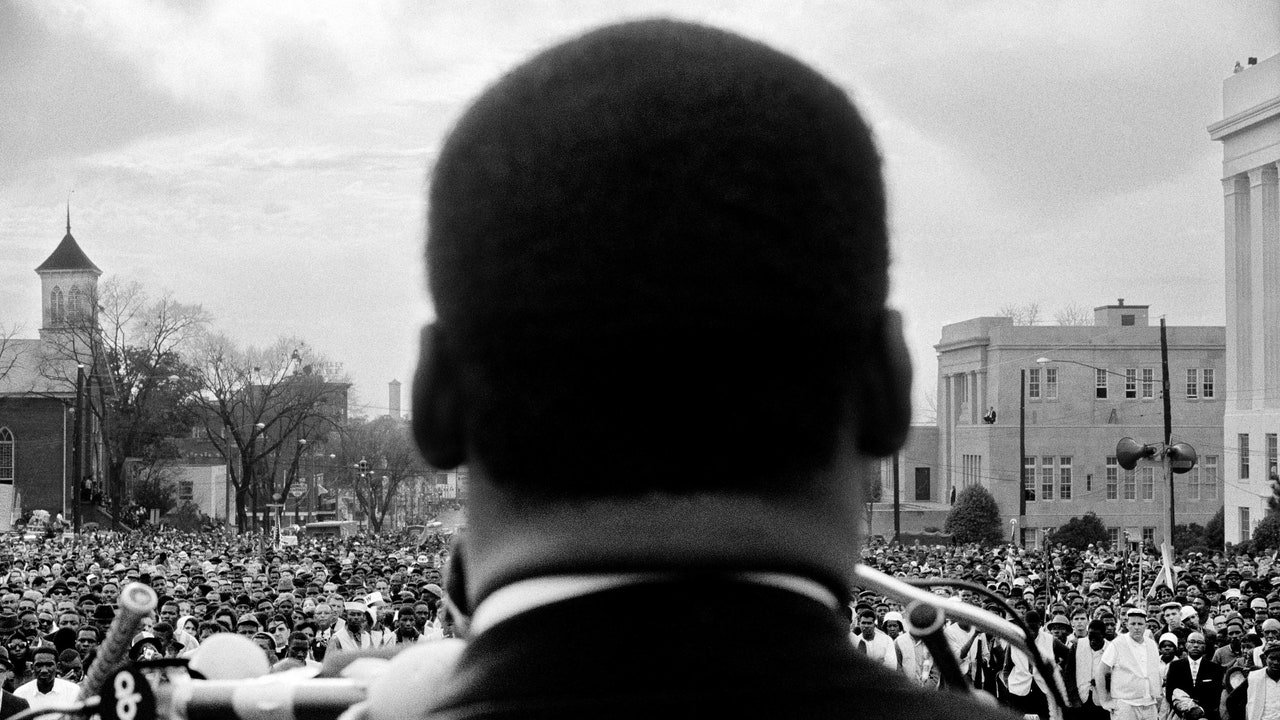
At the intersection of Montgomery Street and Dexter Avenue (the avenue leading to the capitol), Charles Mauldin turned and looked around. “They’re still coming out of St. Jude’s,” a reporter told him. And when the vanguard of the march reached the capitol steps, they were still coming out of St. Jude’s. “You’re only likely to see three great parades in a lifetime,” said John Doar to a student who walked beside him, “and this is one of them.” A brown dog had joined the crowd for the march up Dexter Avenue. On the sidewalk in front of the capitol, reporters stood on the press tables to look back. Charles and the rest of the orange-jacketed three hundred stood below. Behind them, the procession was gradually drawing together and to a halt. Ahead, a few green-clad, helmeted officers of the Alabama Game and Fish Service and some state officials blocked the capitol steps, at the top of which, covering the bronze star that marks the spot where Jefferson Davis was inaugurated President of the Confederacy, was a plywood shield constructed at the order of Governor Wallace—“to keep that s.o.b. King from desecrating the Cradle of the Confederacy,” according to a spokesman for the Governor. Martin Luther King had managed to draw a larger crowd than the leader of the Confederacy a hundred years before.