How will XHS react?
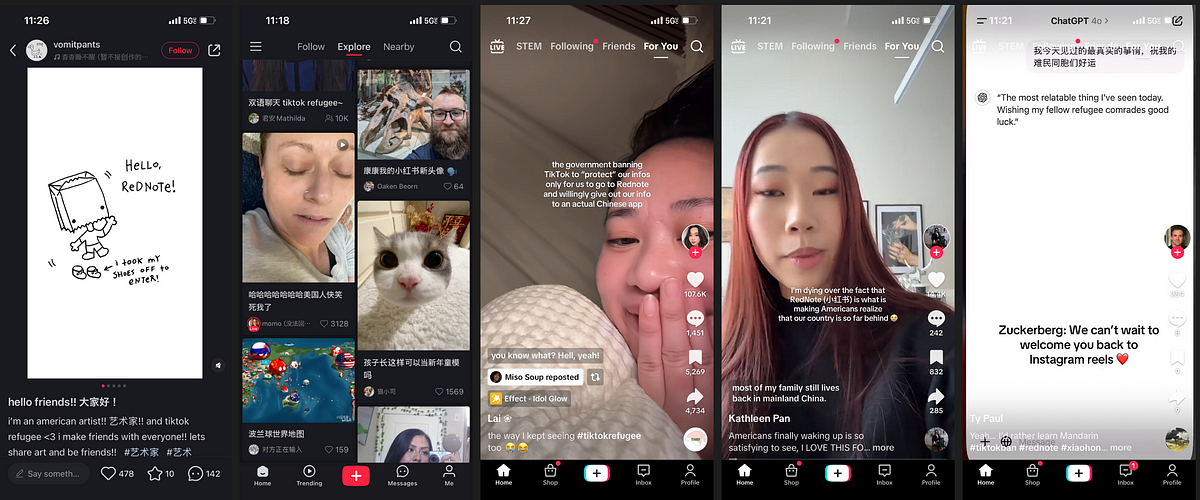
Tiktok has 6 days left until the ban date arrives, and I expect more and more people will flood into XHS and other TikTok copycat apps.
It’s obvious that if XHS gains traction, that it will likely also be banned. This invites a question of double standards with other services like TEMU and Shein, and even with Bytedance having American investors. But I expect in the next week or so we’ll start to see some discussion about XHS taking off now that it is sitting as the number #1 app in the US Apple app store.

Until XHS gets shut down, there will be an incredible experiment being played out.
You see, XHS is a Chinese app, which means you can’t just use it like you would use a Western website. You can’t discuss certain incendiary topics that invite trolls or flamewars, and there is definitely a larger net cast in terms of what topics fall under that ambiguous definition. Most of the Chinese internet is experienced at dealing with censors, getting creative with puns and abbreviations to circumvent word filters. But it’s mainly a spread out chilling effect of those who are brave enough to try and create certain types of content. This spilled over pretty early on into the moderation culture of TikTok (e.g. gen Z slang like “unalive”).
American TikTokers in the past 24 hours have already blown past this. They’ve largely used XHS in the same way that they used TikTok, which is a free for all. There are so many hilarious accounts of TikTokers getting banned or censored immediately on XHS for some content, without realizing what they did wrong. However, rather than pull a “China bad, freedom of speech, etc”, I’ve noticed some are having an attitude of trying to better understand the rules so they can co-exist within them, instead of imposing their standards of free speech on a foreign app with its own existing culture.
The reason why people loved TikTok was because of its culture, which came down to its moderation. TikTok has a positive association of ease and “things arent so serious”. There’s often less bad-faith posting, trolling, flamebaiting, and more connection, conversation, more shareability of content, more genuine authenticity. Some of this is due to functional algorithm design, but IMO most is the culture of the environment that comes from moderation. Conversely, the Western internet is doing a reactionary rebound in the opposite direction with less moderation everywhere, driving the mass migrations and enshittifcation of those platforms.
What is the purpose of a digital commons?
Can XHS actually juggle the new voices that come in? TikTok users will post insane brainrot memes and discuss politics, they WILL broach Chinese internet social norms.
XHS only recently opened up, just like China has only very recently physically opened up with new visa free travel. China has been dipping its toe into letting more foreigners inside its borders, mainly driven by inflation and economic pressure. But, this event is definitely one outside of its control, however timely it may be.
For me, I see two outcomes:
- XHS bans everyone who doesn’t follow the rules, keeps its strict moderation standard, and effectively says “I dont care about new American user base”
- XHS relaxes its moderation, and the culture of XHS (and the Chinese internet) changes for good
I think theres too much money involved for Option 1 to happen. XHS users are currently on par with (and in a lot of cases exceeding) TikTok for revenue generation and social media sponsorship, largely because Chinese social media sponsorship is at an all time high right now.
Option 2 just seems impossible. It’s never happened before. It’s an idealogical risk for Chinese civil society, in a way that would openly admit to everyone what they already knowingly do. VPNs are pervasive, Chinese people pay to watch Marvel movies, young Chinese people are frustrated just the same as young Americans. But to openly embrace all of that on the biggest social media platform in the country? Genuinely unthinkable.
This means, we are seeing for the very first time in history a western influx of internet behavior deep within the great firewall. It has the potential to change how the Chinese internet works. Maybe if those two outcomes represent the two extremes of possibility, and the reality will end up somewhere in the middle. Either way, I cannot believe we’ve arrived at this point.
The fact that the internet can still be dramatically reshaped in 2025 is hilariously encouraging to me.


