A veteran of photography recently told me she’s “really been enjoying AI street photography.” She explained that she had never felt comfortable doing actual street photography. In particular: going out into the world, engaging with strangers, capturing real moments. But now she could finally enjoy the genre without that discomfort.
I had to stop her there. What she’s doing isn’t photography at all.
This isn’t mere semantics. Photography—from photo- “light” + -graph “something written”—means drawing with light onto something¹. You cannot “photograph” something that never existed. No photons were recorded because no moment actually happened. What she’s doing might be art, ML image generation, or what some call “synthography.”² Yet, it cannot, by definition, be photography.
“In the end, your view is just different from mine,” she responded. True. But this is about the collapse of meaning in our rush to simulate experience rather than live it.
Think of it like emulation versus native execution.
We pretend the simulation is equal to the real thing. But that pretense requires ignoring the physics and embodied reality of what’s happening.
The tragedy isn’t linguistic imprecision—it’s what this collapse of meaning represents. Street photography isn’t just about getting images. It’s about being present in the world, engaging with fellow humans, finding the courage to put yourself in uncomfortable situations.
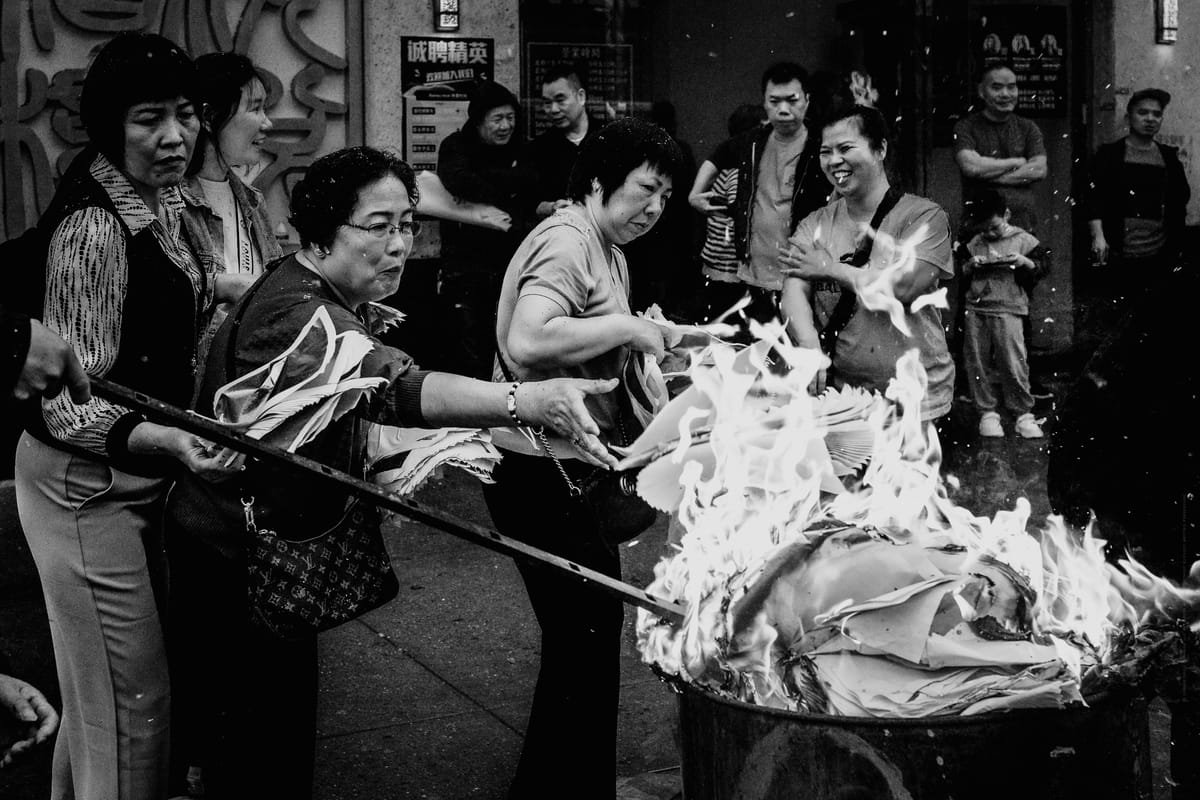
I experienced this truth firsthand recently in Brooklyn’s Chinatown. Unsure of my bearings in an unfamiliar neighborhood, I chose to first observe from the safety of a bus. When I spotted a crowd gathered around two metal barrels, smoke and paper ash in the air, something pulled me off that bus and into the scene.
I found myself the only non-Chinese person among about fifty locals, gathered in two circles around burning fires. Not a word of English spoken. With my camera, I was an outsider, met with skeptical glances. But through careful body language, respectful distance, and genuine curiosity, something remarkable happened. The elder tending the fire caught my eye and smiled. We exchanged thumbs up and a laugh. A wordless permission that transformed me from outsider to welcomed observer. For the next twenty minutes, I documented a ceremony I’d later research and discuss with Chinese friends. But at that moment, I was present, connected, learning.

This is what we sacrifice when we pretend AI image generation is equal to street photography.
No algorithm could have replaced that social dance, the warmth of that man’s smile, or the shift from outsider to accepted observer. These are not photos but artifacts of human connection, of pushing past comfort zones, of cultural exchange.
We’re not just misusing terms—we’re surrendering the very concept of authentic engagement with reality. Automation of the experience.
“But ‘synthography’ isn’t gaining much traction,” she explained, defending her terminology. Of course it isn’t. We prefer comfy illusions to precise truths. It’s easier to pretend we’re doing the same thing as those who actually engage with the world, who actually capture real moments, who actually face the discomfort of genuine human interaction.
This is a classic case of tools displacing users: a device appears making things so easy to the point of undermining our fundamental human capacity to do it ourselves.
And the pattern extends far beyond photography. Everywhere we look, the virtual replaces the physical without acknowledging the fundamental difference. I know this has already happened, but I would like to highlight the process as it unfolds, so you can decide where the value is for you. In which order of reality are you living an embodied experience in? This reality is your anchor. Now. Not a prompt. You won’t find your life in a prompt.
What happens to a culture that becomes comfortable with synthetic versions of real experiences? What dies in us when we stop distinguishing between capturing reality and generating simulacra? What changes when we choose the comfort of artificial engagement over the messy, uncomfortable reality of being present in the world? While I can’t be sure that this reality isn’t already a synthography itself, I am certain that your experience of it depends on getting involved in it. Perhaps Baudrillard would know more.³ I don’t.
Maybe we can’t escape the collapse of meaning, but we can decide how to engage with it.
By all means, generate AI content. Create synthetic images. Enjoy that process.
But don’t collapse the meaning of photography—an art form about engaging with and capturing reality—into something that avoids that engagement. Some distinctions are worth preserving, even if maintaining them makes us uncomfortable.
Because that discomfort is the point.
- Etymology Online. (2024). Photograph. Retrieved from https://web.archive.org/web/20171017074553/etymonline.com/word/photograph.
- The term “synthography” appears to have been independently coined in 2022-2023 by both Reinhuber (https://web.archive.org/web/20221220183225/https://link.springer.com/chapter/10.1007/978-3-030-95531-1_22) and Ango (https://web.archive.org/web/20230906022043/https://stephango.com/synthography), demonstrating convergent thinking about AI-generated imagery. There are more people who could claim it around that time. It’s a simultaneous invention.
- Baudrillard would likely recognize this as the “precession of simulacra” at work: AI photography is not just a copy of reality, but a representation without original. Simulacra.


